The most complex and specialized operations within commercial diving.
At P&P Underwater Solutions, our certified diving welders face the daily challenges of working in extreme conditions to maintain and repair critical underwater structures.
What is Underwater Welding?
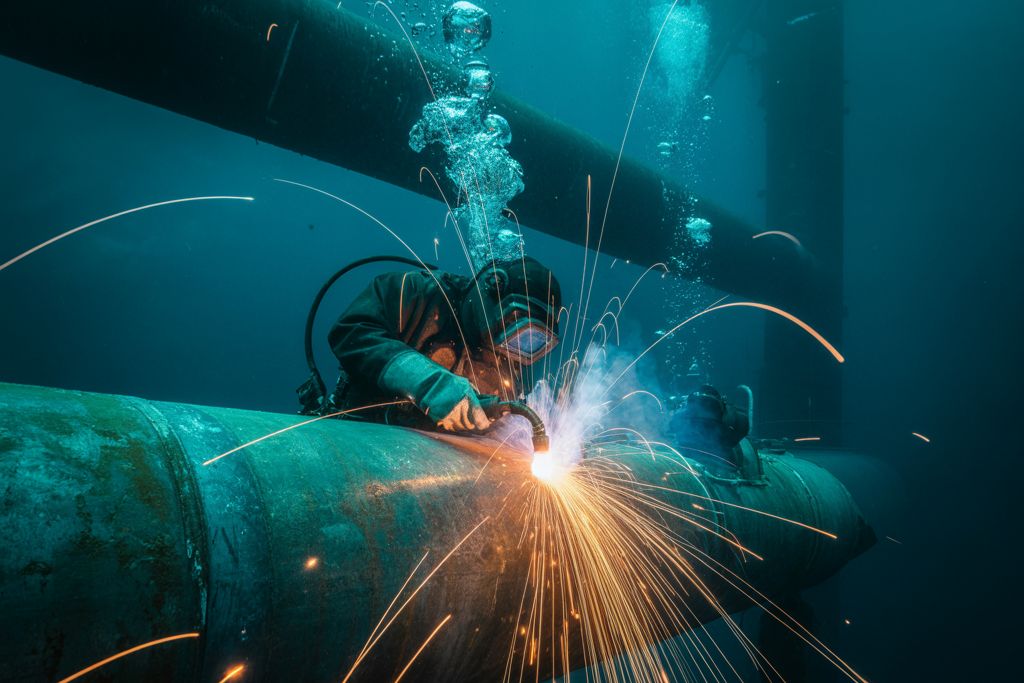
Underwater welding is a process of joining metals that is carried out underwater, whether in the sea, rivers, lakes, or dams. This technique is essential for repairing ships, oil platforms, harbor piles, and pipelines without the need for dry docks or costly dismantling.
Types of Underwater Welding
Wet Welding
It is performed directly in the water, where the diver welder works submerged. It uses special electrodes with waterproof coatings that protect the electric arc from the surrounding water. It is ideal for emergency repairs, port maintenance, and urgent work on ship hulls due to its speed and lower operating costs.
Dry Welding
A dry environment is created around the work area using hyperbaric chambers. The diver works in a controlled atmosphere, allowing for higher quality welds, comparable to surface welding. It is used in critical structural repairs and projects requiring strict quality certification.
Main Technical Challenges
Hydrostatic Pressure
For every 10 meters of depth, the pressure increases by approximately 1 atmosphere. This affects the formation of the electric arc, the behavior of the molten metal, and the mechanical properties of the weld bead.
Accelerated Cooling
Water acts as an extremely effective heat sink, causing rapid cooling of the metal, risk of hydrogen cracking, and formation of hard and brittle metallurgical structures.
Limited Visibility
The turbidity of the water, suspended particles, and bubbles generated by the process make visibility difficult. Diving welders must rely on their tactile experience and technical knowledge, working with visibility of less than 30 centimeters.
Contaminación por Hidrógeno
Water decomposes into hydrogen and oxygen during the process, causing cracking, porosity in the weld bead, and a reduction in mechanical properties. This necessitates the use of special low-hydrogen electrodes.
Electrical Safety
Working with electricity underwater requires equipment with certified special insulation, automatic cut-off systems, rigorous safety protocols, and continuous specialized training.
Applications in Peruvian Industry
Port Sector
Reparación de pilotes y defensas, mantenimiento de muelles y refuerzos estructurales.
Fishing Industry
Repair of boat hulls and maintenance of cultivation structures.
Energy Sector
Maintenance of underwater pipelines, repairs at thermoelectric plants and offshore work.
Naval Infrastructure
Emergency repairs on ships and maintenance of Navy facilities.
Standards and Certifications
At P&P Underwater Solutions, we operate under strict international standards such as AWS D3.6M (underwater welding), ASME Section IX, ISO 15618, and DICAPI regulations. All our diver welders hold current and up-to-date certifications.
Welding Process Step by Step
- Preliminary Inspection: Visual and photographic evaluation
- Surface Preparation: Cleaning by brushing or pressure washing
- Equipment Configuration: Parameter adjustment according to depth
- Welding Execution: Application of certified laces
- Post-Welding Inspection: Verification and non-destructive testing
- Documentation: Photographic record and detailed technical report
Quality control
Quality is verified through underwater visual inspection, penetrant testing, underwater ultrasound, hardness testing, and comprehensive photographic documentation.
When do you need underwater welding?
Request our services when there are breaks in submerged structures, underwater reinforcements are required, there are leaks in hulls, dry dock time is prohibitive, or an urgent repair is needed for operational continuity.
La Diferencia P&P Underwater Solutions
Our experience sets us apart with internationally certified diver welders, 24/7 rapid response, certified top-of-the-line equipment, current DICAPI and APN licenses, complete documentation with photographic evidence, and strict compliance with international standards.
Conclusion
Underwater welding combines knowledge of metallurgy, commercial diving, industrial safety, and practical experience. With the right equipment, certified personnel, and established procedures, it's possible to perform high-quality repairs in extreme environments, keeping your marine operations running smoothly.
Do you need underwater welding services?
Contact us to assess your situation and provide a fast, safe, and certified quality solution.
P&P Underwater Solutions S.A.C
Specialists in Underwater Operations and Commercial Diving
Valid licenses: DICAPI | APN
24/7 assistance for maritime emergencies