The heart of global maritime and energy infrastructure relies on metal structures that withstand the constant battering of the sea. When these structures require maintenance, repair, or expansion, the work does not stop: it must be carried out underwater. This is where the Diving and Underwater Welding emerges as one of the most critical and specialized skills in the maritime industry.
Unlike welding on land, welding in an aquatic environment is a challenge that combines advanced engineering, specialized technology, and the rigorous profile of a highly trained commercial diver.
What is Underwater Welding?
Underwater welding is a specialized metal joining process performed underwater, usually to repair or modify submerged metal structures such as oil platforms, ships, pipelines, or bridges.
There are two main methodologies, defined by the environment in which the diver-welder operates:
Wet Welding
This is the most common and versatile method. It involves welding directly exposed to water, using electrodes designed to be resistant to water and the marine environment.
- Advantages: It is fast, flexible, and has lower operating costs, as it does not require the construction of a dry habitat.
- Disadvantages: Rapid cooling by water can affect the metallurgical quality of the weld, so it is mainly used for non-critical or temporary repairs.
Dry Welding (or Habitat Welding)
Considered the pinnacle of underwater welding. The diver works inside a sealed structure or chamber (a “habitat”) from which water has been removed, creating a dry, pressurized environment.
- Advantages: It allows the same quality and standards to be achieved as terrestrial welding. It is ideal for critical high-pressure joints (such as gas pipes or oil pipelines).
- Disadvantages: It requires complex and costly camera mounting, as well as more elaborate life support systems for the diver.
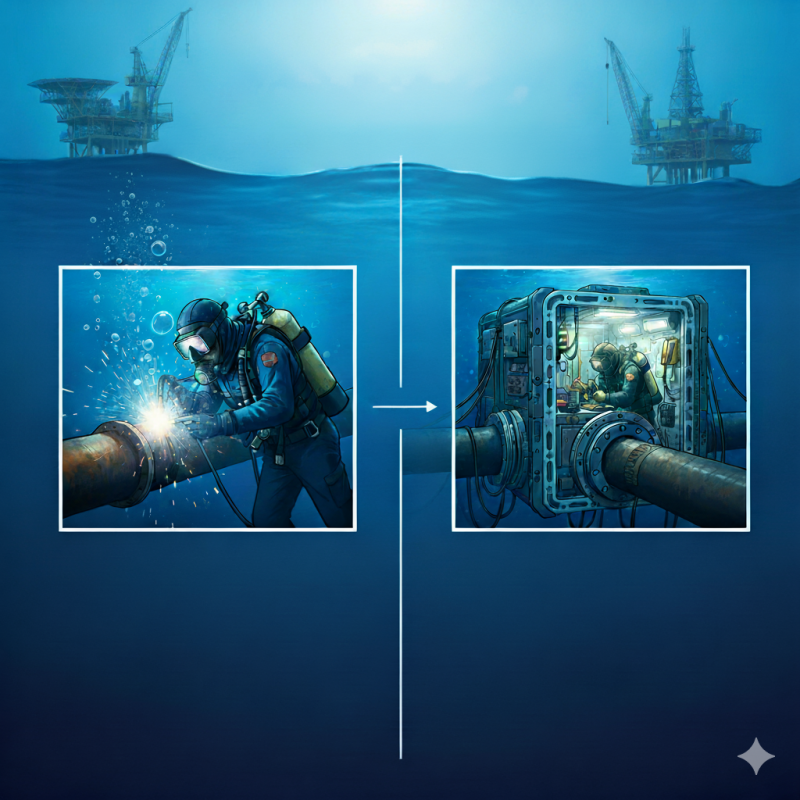
Wet welding Dry welding
Critical Applications in Industry
The ability to weld and build underwater is essential to maintaining the operability of the most important sectors of the maritime economy:
- Offshore Platforms: Repair of support structures (jackets) damaged by corrosion or impact from boats.
- Ships and Boats: Emergency repairs to the hull, without having to take the boat to a dry dock.
- Pipes and Pipelines: Installation of new sections, repair of leaks or emergency joints in energy and resource transport systems.
- Bridges and Docks: Strengthening and repairing piles and submerged structures to ensure the stability and safety of port infrastructure.
The Profile of the Diver-Welder: A Double Specialist
Becoming a diver-welder is a rigorous process that requires a high level of dual specialization:
- Commercial Diver Certification: Comply with international safety and diving standards (such as IMCA, ADCI, or national regulations).
- Welder Certification: Obtain specific welding certifications, often under the American Welding Society (AWS), in particular the AWS D3.6M: Specification for Underwater WeldingThis standard classifies the quality of the joint (Class A, B, C, etc.).
The professional must master not only the use of diving equipment and hyperbaric chambers, but also cutting and measuring techniques, and, of course, the handling of electric arcs in adverse conditions.