Commercial diving is not an office job. It's a demanding, dangerous profession that requires a very high level of specialization. Naturally, this leads many people to wonder: "Is the risk and investment worth it? How much does a commercial diver actually earn?«
The answer isn't simple, as a professional diver's salary can vary drastically. Factors such as experience, specialization, geographic location, and project type play a crucial role in determining earnings. In this post, we'll break down the main elements that influence a commercial diver's salary potential.
Base Salary: A High Starting Point
It's important to note that a commercial diver's salary is typically significantly higher than that of many other professions, even at entry levels. This is due to the high-risk and high-skill nature of the work.
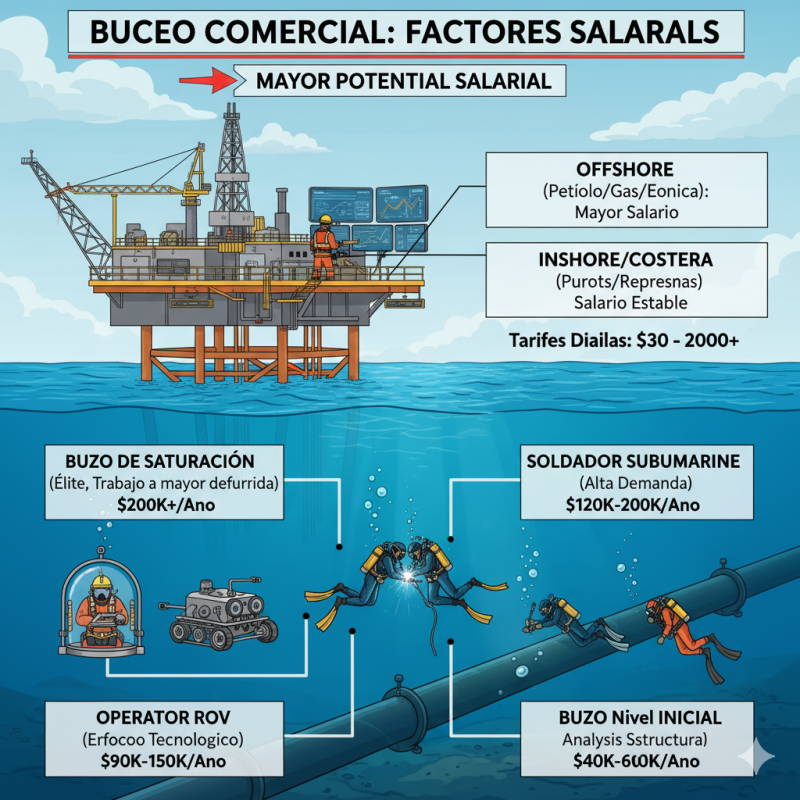
On average, a newly qualified commercial diver in some regions can start earning between $40,000 and $60,000 USD per year. However, this is just the tip of the iceberg. Experienced and highly specialized divers can earn over $100,000 USD annually, and even reach much higher figures on specific, high-demand projects.
Key Factors that Influence Salary
1. Experience and Seniority
As in any profession, experience is a determining factor. A diver with years of service and a proven track record of successful projects will be more valued and, therefore, better paid.
- Junior/Entry-Level Divers: Recent graduates, apprentices, or those with little experience.
- Intermediate Divers: With several years of experience, capable of handling a variety of tasks with little supervision.
- Senior/Expert Divers: With decades of experience, often supervising teams, managing complex projects, or with rare specializations.
2. Level of Specialization and Certifications
This is where commercial divers can really differentiate their earning potential. The more specialized skills and certifications they have, the greater their value in the market:
- Underwater Welder: One of the highest-paying specialties due to its complexity and demand for quality (especially dry welding).
- Non-Destructive Testing (NDT) Technician: Skills to detect faults in underwater structures without damaging them (ultrasound, magnetic particles).
- Saturation Diver: Highly specialized for working at great depths and for very long periods, living in decompression chambers. They are the elite of commercial diving and among the highest paid.
- ROV (Remotely Operated Vehicle) Operator: Although it is not diving itself, many divers train in this complementary area.
- Diving Supervisor: Leadership and security role on the surface, requiring extensive experience.
3. Geographic Location and Project Type
The location where the work is performed and the specific industry also have a significant impact:
- Offshore Diving (Oil Rigs, Offshore Wind Energy): Generally the best-paid jobs due to the depth, extreme conditions, duration of projects (months away from home), and high-investment industry.
- Diving in Ports and Inland Waters: Maintenance of docks, ships, bridges, dams. These salaries are often lower than offshore jobs, but they offer more stable work closer to home.
- Rescue/Recovery Diving: It can vary greatly depending on the emergency.
- Scientific/Archaeological Diving: Generally well paid, but with fewer opportunities and often funded by projects or institutions.
4. Work Arrangement (Per Day, Per Project, Per Contract)
- Some divers work on a contract basis on specific projects, which can mean very high income during that period, but with periods of inactivity between projects.
- Others may have more stable employment with a company, with a base salary and benefits.
- Daily rates can range from $300 USD para un buzo junior hasta más de $1,000 – $2,000 USD for a saturation diver or an offshore underwater welder.