For many, their first dive into the ocean is a transformative experience. The feeling of weightlessness, the marine life, and the tranquility of the environment create a deep connection with the underwater world. Recreational diving allows you to explore spectacular landscapes, but as that passion grows, a crucial question arises:
How does a recreational diver become a professional commercial diver?
The transition is not easy. It is a technical and mental leap that transforms a hobby into one of the most demanding, specialized, and well-paid professions in the maritime field. If you are looking to make the ocean your office, this article summarizes the key differences and the training path required to enter commercial diving.
Fundamental Differences Between Recreational Diving and Commercial Diving
The differences between the two worlds are not limited to equipment or depth. They change the purpose, mindset, responsibility, and work environment.
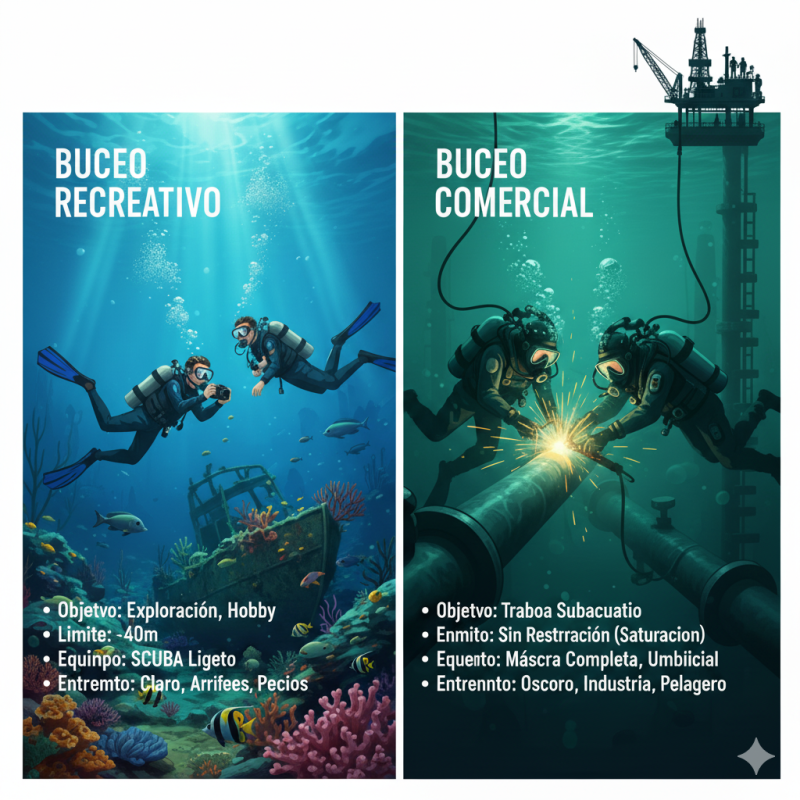
1. Purpose
- Recreational: Exploration, leisure, wildlife watching, and personal enjoyment.
- Commercial: Technical tasks such as inspection, construction, welding, rescue, or infrastructure installation. The mission is to perform a specific job with precision and safety.
2. Work Environment
- Recreational: Clear, warm waters with good visibility, generally in tourist areas.
- Commercial: Murky, cold water with zero visibility, strong currents, and industrial environments such as ports, dams, pipelines, oil rigs, or collapsed structures.
3. Equipment
- Recreational: Mask, fins, buoyancy compensator, air tank, and lightweight wetsuit.
- Commercial: Surface diving helmet, umbilical cord with continuous air supply, heavy dry suit, boots, hydraulic or pneumatic tools, and direct communication with the surface. In advanced work, diving bells and hyperbaric chambers are used.
These differences show that commercial diving is not just a professional variant of recreational diving, but a completely different discipline.
The Rigorous Training Process
Becoming a commercial diver requires intensive, specialized, and regulated training. Recreational certifications such as PADI or SSI are not sufficient. The path involves meeting strict requirements and completing internationally recognized training.
1. Initial Requirements
- Minimum age: 18 years old.
- Health and fitness: Excellent physical condition, hyperbaric medical evaluations, cardiovascular, pulmonary, and neurological tests.
- Water skills: Strong swimming ability and comfort in the water.
- Mental resilience: Ability to work in stressful, cold, dark, or zero-visibility environments.
2. Training at a Commercial Diving School
Certification must be based on standards from international organizations such as IMCA, ADCI or equivalent national regulations.
The program includes:
Advanced theory
- Physics of diving and pressure.
- Gas management and decompression systems.
- Human physiology under pressure.
- Emergency planning and advanced first aid.
Practical training
- Handling of hulls and umbilicals.
- Operation of gas panels and hyperbaric chambers.
- Use of underwater hydraulic and pneumatic tools.
- Underwater cutting and welding.
- Structure inspection and NDT techniques.
- Rescue procedures and emergency management.
The duration varies between months and more than a year, depending on the specializations chosen (surface, offshore, saturation, underwater welding, etc.).
The Change in Mindset: From Amateur to Professional
The greatest transformation occurs in mindset. Commercial diving requires:
Discipline and responsibility
Every task involves risks. Commercial divers are responsible not only for their own safety, but also for the operational success of an industrial project.
Coordinated work
Unlike recreational diving, commercial divers are totally dependent on surface support: supervisors, tenders, panel operators, and technicians.
Adaptability
You have to work in unpredictable situations: strong currents, zero visibility, cold temperatures, or deteriorated structures.
Resilience
The physical and mental pressure is constant. Emotional strength is required to endure long hours, confined spaces, and extreme conditions.
Conclusion
The transition from recreational diver to commercial diver is not simply a step up in certification level; it is a complete change of discipline. It requires specialized training, a professional mindset, technical mastery, and a commitment to safety. For those seeking a challenging and well-paid career in the underwater world, the path of commercial diving represents a unique opportunity.